A different landscape beside the cinema city
Ouarzazate’s earthen buildings and film sets make strong first impressions. Mansour Eddahbi offers another way to spend part of a stay: looking carefully at water, open land and the movement of birds. The Key Biodiversity Areas database places the reservoir east of Ouarzazate. Treat a visit as a focused landscape outing rather than a waterfront attraction with guaranteed facilities. The reward is having time to notice how the scene is arranged, without needing to fill every moment with an activity.
Understand the wetland before choosing a stop
The Ramsar record for Moyenne Dr’a includes the reservoir and downstream oases. This gives a visit ecological context beyond a scenic photograph. It does not provide a visitor entrance, a current path or permission to cross land. Start with our reservoir guide, then ask a local host or nature guide which viewpoint is suitable for the day you want to go. Explain whether you want a short view from near the vehicle or a longer walk. Those are different requests and may require different arrangements.
Let the water level shape expectations
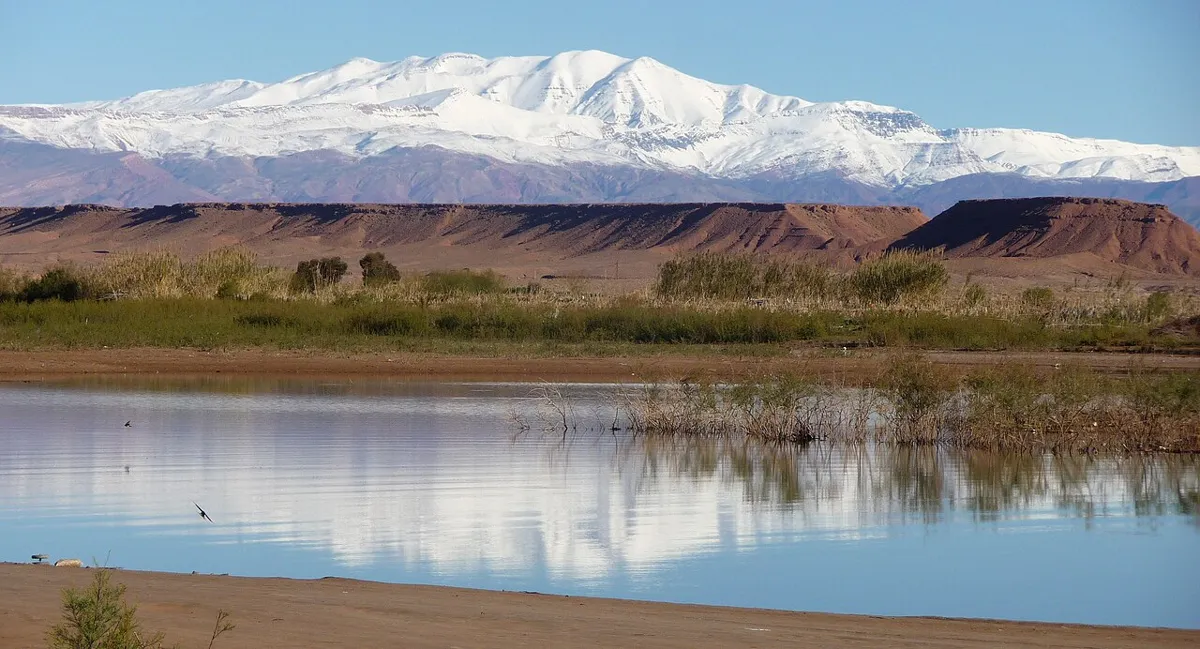
Do not use the distance between a road and blue water in an old photograph to plan a walk. The shoreline is not a fixed promenade, and the scene you find may differ considerably from an image. Ask where you can stop, what the approach is like and whether the proposed viewpoint is currently usable. Choose a clear turnaround point before setting off. A broad view over land and water can be worthwhile without reaching the water’s edge. The photograph illustrating this article was taken in 2011, not during a current inspection.
Watch birds without turning observation into pursuit
Bring binoculars if you have them and begin by staying still. Look across several parts of the view instead of heading directly towards the first bird you notice. Write down what it does, where it stands and how it moves before trying to name it. If birds repeatedly move away as you approach, stop and give them more room. Avoid playback recordings, feeding or following a bird towards a nest. Ask a guide about recent observations, but treat any species list as context rather than a promise of sightings on your visit.
Make a simple observation session
For a beginner, choose three questions: what is moving on the water, what is using the shore, and what is crossing overhead? This works even when you cannot identify species. A notebook helps separate what you actually saw from what you hoped to see. With children, take turns finding shapes, reflections and movement from the same comfortable stopping point. Keep the session short enough that everyone stays interested. You do not need a long walk or an expensive camera to look more closely at a landscape.
Plan transport and comfort together
Agree the actual meeting point, route, waiting arrangements and return with your driver. A map marker for the reservoir is an area reference, not a confirmed parking place. Ask about walking surfaces, shade and somewhere to sit if these matter to your group. Take drinking water, sun protection and shoes suitable for the agreed approach; bring an extra layer when conditions call for it. Do not assume a café or toilets at the stop. Make food and rest part of the plan in Ouarzazate rather than depending on unconfirmed shoreline services.
Keep the outing within its purpose
This guide describes observation from a permitted viewpoint. It does not establish that swimming, boating, fishing or access to dam infrastructure is available. If one of those is your reason for travelling, obtain specific current information from the responsible operator or authority first. Stay out of restricted areas, leave gates and access routes clear, and ask before entering cultivated land. Carry litter back with you. A nature visit works better when you leave the place and its ordinary uses undisturbed.
Pair it with a city visit, or keep it separate
A short confirmed reservoir stop can be contrasted with time around Taourirt Kasbah. Keep the two arrangements flexible rather than promising a packed circuit. If your main interest is cultivated oasis life, compare Fint or Skoura and choose the landscape you most want to understand. These destinations are not interchangeable backups with identical travel demands. Use our trip planner to organise the day, then confirm the final transport and access details locally.
Sources and planning note
Reviewed on 28 October 2026. The Key Biodiversity Areas entry identifies the site and its setting; its assessment history is not a live wildlife report. The Ramsar documentation explains the broader wetland context. Neither source confirms today’s water level, vehicle access or visitor services. Reconfirm your intended stop before leaving, and keep enough flexibility to enjoy a different view from the one in the photograph.
References and photograph licence: https://www.keybiodiversityareas.org/en/site/factsheet/6510 · https://rsis.ramsar.org/RISapp/files/RISrep/MA1482RIS.pdf · gailhampshire, CC BY 2.0: https://creativecommons.org/licenses/by/2.0/
Updated: